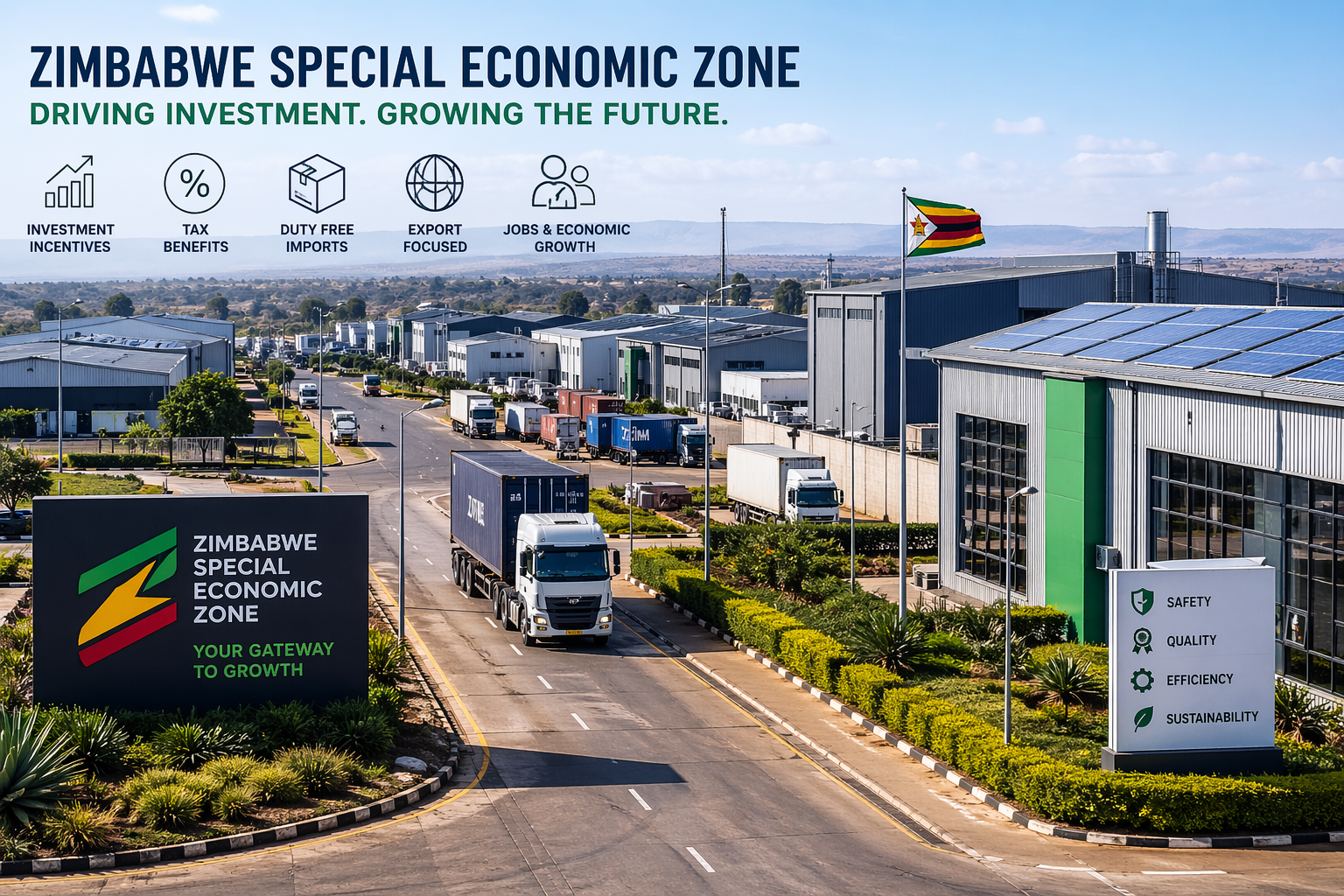
A board may approve a Zimbabwe manufacturing project because the projected Special Economic Zone tax treatment improves the investment case. Then the implementation team discovers that a general investment approval does not create SEZ status, and the proposed site does not yet carry the right lease.
A ZIDA licence can support an investment in Zimbabwe, but foreign investors need to select the correct licensing track before they commit capital, equipment or contractual deadlines. The Zimbabwe Investment and Development Agency, ZIDA, regulates investment licensing and Special Economic Zones. ZIMRA administers the tax and customs side.
Start with the investment you are actually making
ZIDA operates different routes for a general investment and for an investment inside a Special Economic Zone. The distinction matters because an SEZ Investor Licence gives access to the SEZ framework, while a general ZIDA licence does not.
Do not treat a location in or near a designated zone as enough. An investor must hold the relevant SEZ licence and have a developer or operator lease within the SEZ. This is the first point we test during investment advisory work because location claims often appear in project presentations before the tenure documents are ready.
What is ZIDA?
The Zimbabwe Investment and Development Agency is the statutory investment promotion and licensing authority. For an investor entering Zimbabwe, ZIDA is the regulator for the investment licence process. It is not the tax collector, customs authority or exchange-control authority.
That division of responsibility affects execution. A ZIDA approval does not remove the need to meet ZIMRA tax and customs requirements, and it does not override Reserve Bank of Zimbabwe approvals required under the Exchange Control Act.
Choose the right licence before you file
An SEZ Investor Licence suits a company that will conduct approved activities from premises in a designated Special Economic Zone. The licence lasts for 10 years under the current ZIDA framework, effective from 14 November 2023.
A foreign investor that will develop or operate the zone itself needs a separate Developer’s or Operator’s Permit. That permit also runs for 10 years, but it involves a different commercial role, fee structure and land requirement. SEZ designation for a developer or operator requires land ownership or a lease of at least 25 years.
If your business only wants to rent a factory or warehouse in an established zone, do not pursue a developer permit. Focus on securing an appropriate lease and an SEZ Investor Licence. If your business will provide the serviced land, buildings or zone operations, the developer or operator route needs early legal and commercial planning.
ZIDA licence requirements for an SEZ investor
ZIDA receives applications through its DIY Investor Licensing Portal. Build the file before the portal submission starts. A thin application usually creates delay because the project story, premises documents and funding evidence must tell the same story.
For an SEZ Investor Licence, ZIDA requires:
1. Company registration documents. These establish the legal entity that will make the investment. Complete company registration before filing where the chosen structure requires a Zimbabwe entity.
2. A statement of proposed activities. This should explain what the business will manufacture, process, store, export or provide from the zone. Avoid broad wording such as “general trading” where the operating model is more specific.
3. A developer or operator lease within the SEZ. The lease links the investor to the zone and shows that the project has premises.
4. Proof of at least US$50,000 in convertible foreign currency. ZIDA requires this evidence because the SEZ route is intended for capitalised investment activity, not a paper company without funding.
5. A non-refundable US$1,000 application fee. Pay it as part of the application process and treat it as a sunk cost even if the project timetable changes.
The proposed-activities statement deserves more attention than most investors give it. It should align with the lease, capital budget, supply chain and staffing plan. If the application describes export-oriented processing but the commercial plan depends on local retail sales, the inconsistency can become a regulatory problem later.
Worked example: a leased processing facility
Take an illustrative foreign-owned food processor planning to lease premises in an established Zimbabwe SEZ. It has US$400,000 available for equipment and working capital, so it meets the US$50,000 convertible-currency evidence threshold. It prepares a company registration pack, signs a lease with the zone operator and describes the processing activity precisely in its ZIDA application.
Its direct SEZ Investor Licence charges are US$1,000 to apply, US$10,000 on approval and US$2,500 each year after approval. The initial approval-stage outlay is therefore US$11,000 before the annual charge, excluding lease, professional and operating costs. The team would avoid a common mistake by confirming whether intended local sales need separate approval before it imports stock or makes customer commitments.
ZIDA licence fees and the developer route
An SEZ Investor Licence application costs US$1,000 and ZIDA charges US$10,000 on approval. The annual fee is US$2,500. These charges apply to the investor licence route and are separate from the project’s premises, company registration, tax-compliance and advisory costs.
A Developer’s or Operator’s Permit costs US$1,000 at application, US$20,000 on approval and US$5,000 annually. The higher approval and annual charges reflect the wider responsibility of establishing or operating SEZ infrastructure.
We recommend that investors place these fees in the acquisition and launch budget, rather than in a general contingency line. The figures are modest beside an industrial project, but missing them can hold up a filing that depends on board approval or a lease deadline.
Worked example: an investor considering its own industrial park
Take an illustrative regional logistics group that wants to establish a dedicated industrial park rather than lease an existing SEZ unit. It proposes to control the land through a 30-year lease, which exceeds the minimum 25-year lease period required for SEZ designation. The group needs a Developer’s or Operator’s Permit, not merely an SEZ Investor Licence.
Its initial permit charges are US$21,000, made up of the US$1,000 application fee and US$20,000 approval fee, followed by US$5,000 annually. The decision should turn on more than incentives: the group must assess infrastructure costs, tenant demand and the governance burden of operating the site. If it only needs one facility, leasing from an existing developer will usually present a cleaner risk profile.
What SEZ incentives can provide
ZIDA advertises a principal corporate income tax offer of 0% for the first five years of qualifying SEZ operations and 15% thereafter. ZIMRA separately lists the general company tax rate at 25%, so the difference can materially affect forecasts where the project qualifies and earns taxable profits.
Do not place the 0% rate into an investment model without a specific eligibility review. The stated effective date is 1 January 2018, and project activities, tax treatment and exclusions need confirmation before reliance. A licence is central to the framework, but it does not turn every revenue stream into qualifying SEZ income.
ZIDA also lists the following SEZ incentives:
● A 100% customs-duty rebate on imported raw materials, equipment and machinery.
● A special initial allowance of 50% in year one and 25% in each of the next two years.
● Exemptions from non-resident withholding tax on qualifying unavailable offshore services, royalties and dividends.
These incentives carry an effective date of 2017. They can improve project economics, particularly where machinery imports form a large part of the capital budget, but the import documentation and qualifying use need careful control.
An SEZ-licensed investor generally does not need Control of Goods Act import or export permits for qualifying imports and exports. The rule does not create an open channel into the domestic market. Goods moving from an SEZ into Zimbabwe’s customs territory face the permit requirements that apply to imports.
Retail activity needs prior approval from ZIDA and ZIMRA. This matters for a manufacturer that expects to test products through local outlets or a foreign investor whose group model includes direct-to-consumer sales. Raise the domestic sales plan before licensing, not after inventory reaches the zone.
The 2026 tax issue for multinational groups
Finance Act 2025 took effect on 1 January 2026. It raised Zimbabwe’s general VAT rate to 15.5% and introduced a domestic minimum top-up tax for multinational groups with annual revenue of at least US$750 million where their Zimbabwe effective tax rate falls below 15%.
For an in-scope multinational group, the SEZ corporate income tax rate may no longer deliver the same group-level benefit that a five-year 0% headline rate suggests. Tax leaders should model the Zimbabwe effective rate, group ownership structure and top-up tax exposure before presenting an SEZ incentive as a permanent saving.
This is where tax compliance and investment advisory need to work together. A licensing team can secure the correct ZIDA route, but the group tax team must test whether the incentive survives the minimum-tax rules.
Exchange control, customs and operating discipline
Foreign-currency accounts and fund movements remain subject to Exchange Control Act approvals where required. Investors must make a prior written declaration to the Reserve Bank of Zimbabwe for fund movements that require it.
Do not assume that an SEZ licence creates unrestricted movement of dividends, loan repayments or offshore service payments. Include exchange-control review in the transaction timetable, especially where shareholder funding or offshore intellectual-property charges form part of the business model.
The operating file should also remain current after approval. Keep the ZIDA licence, lease, import records, tax registrations, customs documents and funding evidence in one governance file. When a project changes activity, ownership, premises or domestic-market exposure, assess the regulatory impact before implementing the change.
A practical filing sequence
1. Define the operating model
Write down the activity, product flow, site, export plan and domestic sales plan. This determines whether an SEZ Investor Licence fits and whether extra approvals may apply.
2. Secure the correct premises position
For an investor licence, obtain the developer or operator lease within the SEZ. For a developer or operator project, confirm land ownership or a lease of at least 25 years before treating the designation as achievable.
3. Establish the investment vehicle
Complete company registration documents and ensure the shareholder, director and activity details match the investment plan. Misalignment between corporate records and the ZIDA application creates avoidable questions.
4. Assemble evidence of funding
Prepare proof of at least US$50,000 in convertible foreign currency for an SEZ Investor Licence. The evidence should show that the applicant can fund the project it describes.
5. Model tax and customs treatment
Test the 0% and 15% SEZ tax assumptions against actual qualifying income, customs flows and the 2026 minimum top-up tax rules for groups at or above US$750 million revenue. This prevents an incentive claim from becoming an unsupported board assumption.
6. File through the DIY Investor Licensing Portal
Submit the application to ZIDA with the required documents and pay the US$1,000 non-refundable fee. Keep a controlled copy of everything submitted, including the proposed-activities statement.
7. Build the post-licence compliance calendar
Track the US$2,500 annual SEZ Investor Licence fee or US$5,000 Developer’s or Operator’s Permit annual fee, tax filings, customs obligations and any exchange-control approvals. Governance after approval protects the value of the licence.
Frequently Asked Questions
Is a general ZIDA licence the same as an SEZ Investor Licence?
No. They are separate licensing tracks. An investor that wants SEZ treatment needs an SEZ Investor Licence and premises through a developer or operator lease within a designated SEZ.
How much does an SEZ Investor Licence cost in Zimbabwe?
The application fee is US$1,000, the approval fee is US$10,000 and the annual fee is US$2,500. The application fee is non-refundable.
Do SEZ investors pay zero corporate income tax?
ZIDA advertises 0% corporate income tax for the first five years and 15% thereafter for qualifying SEZ operations, with the 2018 effective date marked. Eligibility, income type and the 2026 domestic minimum top-up tax require project-specific review.
Can an SEZ investor sell goods in Zimbabwe?
Domestic sales remain regulated. Goods entering Zimbabwe’s customs territory face import-type permit requirements, and retail activity requires prior ZIDA and ZIMRA approval.
A well-structured ZIDA licence application starts with the commercial model, then tests tax, premises and regulatory assumptions against it. Speak With Our Team to assess the appropriate ZIDA route, SEZ eligibility and compliance plan for your Zimbabwe investment.