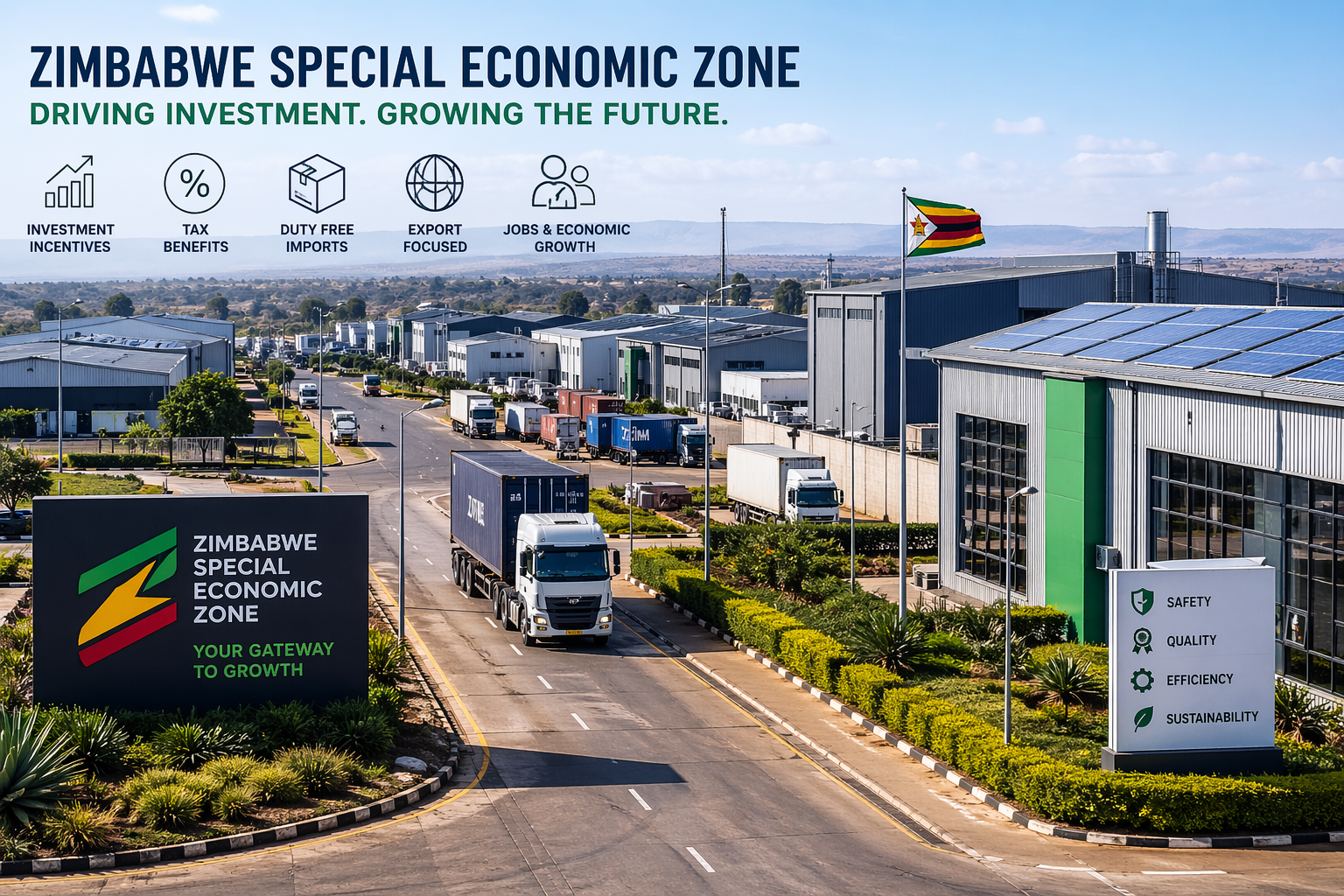
Introduction: Incentives Are Only Valuable If You Can Use Them
Zimbabwe’s Special Economic Zones (SEZs) are often marketed as a gateway to tax efficiency, export growth, and industrial expansion. On paper, the incentives are compelling.
But for investors and operators, the real question is not what exists, it’s what works in practice.
In 2026, SEZs remain one of the most strategic (and misunderstood) tools under the Zimbabwe Investment and Development Agency Act, administered by the Zimbabwe Investment and Development Agency (ZIDA).
This guide breaks down the actual incentives available, how to access them, and where the pitfalls lie.
What Is a Special Economic Zone in Zimbabwe?
An SEZ is a designated area, or approved project, where businesses operate under preferential regulatory and tax conditions to encourage investment.
SEZs in Zimbabwe are not limited to geographic zones. They can also be:
- Sector-specific projects
- Export-oriented operations
- Individually licensed investments
Approval is granted by the Zimbabwe Investment and Development Agency, which evaluates both the economic impact and compliance profile of the investor.
Core Incentives Available in 2026
1. Corporate Tax Incentives
SEZ investors typically benefit from:
- Reduced corporate tax rates for a defined period
- Potential tax holidays depending on project structure
This is one of the most attractive features, particularly for capital-intensive industries.
2. Duty-Free Importation of Capital Equipment
Approved investors can import:
- Machinery
- Raw materials
- Capital goods
Without paying customs duty
This significantly lowers setup costs, especially for manufacturing and industrial projects.
3. VAT Relief and Refund Mechanisms
SEZ operators may benefit from:
- VAT exemptions on certain inputs
- Accelerated VAT refund processes
This improves cash flow, an often-underestimated advantage.
4. Repatriation of Profits
Investors are generally allowed to:
- Repatriate dividends
- Externalize profits and capital
Subject to exchange control regulations, this is critical for foreign investors evaluating risk.
5. Streamlined Licensing and Approvals
Through the Zimbabwe Investment and Development Agency, SEZ investors benefit from:
- A “one-stop shop” for approvals
- Faster licensing processes
- Coordinated regulatory engagement
In theory, this reduces bureaucratic friction.
6. Export Incentives
SEZs are designed to promote exports, offering:
- Favourable treatment for export-oriented businesses
- Potential additional incentives tied to foreign currency generation
Who Qualifies for SEZ Status?
Not every business qualifies.
ZIDA typically prioritizes:
- Export-oriented industries
- Manufacturing and value addition
- Infrastructure and large-scale projects
- Technology and innovation-driven enterprises
Applications are assessed based on:
- Economic impact
- Job creation potential
- Foreign currency generation
- Alignment with national development priorities
The Reality Check: Where Investors Get Caught Off Guard
1. Approval Is Discretionary, Not Automatic
SEZ status is not guaranteed. Even strong projects can face:
- Delays in approval
- Requests for additional information
- Conditional licensing
Preparation and positioning matter.
2. Incentives Come with Compliance Obligations
To retain SEZ benefits, investors must:
- Meet performance targets
- Maintain proper reporting
- Comply with tax and regulatory requirements
Failure to comply can result in:
- Withdrawal of incentives
- Penalties
- Reclassification under standard tax rules
3. Exchange Control Realities Still Apply
While profit repatriation is permitted, it operates within Zimbabwe’s broader foreign exchange framework.
Delays or restrictions can still occur, particularly in periods of currency pressure.
4. Infrastructure Constraints Can Offset Incentives
In some cases:
- Power supply issues
- Logistics challenges
- Limited industrial infrastructure
can reduce the practical value of SEZ incentives.
Incentives do not eliminate operational risk, they only offset it.
Strategic Considerations Before Applying
For investors evaluating SEZ opportunities, the key is not just qualification, it’s alignment.
Ask:
- Does my business model genuinely benefit from export incentives?
- Are the tax savings significant relative to compliance costs?
- Can I meet performance and reporting requirements?
- Is my project structured to maximize available benefits?
SEZ status should support your strategy not define it.
The Advisor’s Role: Turning Incentives into Value
This is where many projects succeed or fail.
Advisors play a critical role in:
- Structuring investments to qualify for incentives
- Navigating ZIDA application processes
- Ensuring ongoing compliance
- Aligning tax planning with operational realities
Poor structuring can leave incentives on paper but not in practice.
Call to Action: Don’t Just Apply, Position Strategically
If you are considering investing in Zimbabwe or expanding an existing operation:
Now is the time to evaluate whether SEZ status is right for you.
Start with:
- A feasibility assessment of your eligibility
- A financial model comparing SEZ vs non-SEZ scenarios
- Early engagement with the Zimbabwe Investment and Development Agency
- Professional advice on structuring and compliance
The difference between a successful SEZ project and a missed opportunity is rarely the incentive, it’s the strategy behind it.
Conclusion: Incentives Are Tools, Not Guarantees
Zimbabwe’s Special Economic Zones offer real, tangible benefits in 2026.
But incentives alone do not create successful investments.
The investors who benefit most are those who:
- Understand the rules
- Structure their projects carefully
- Execute with discipline
In the end, SEZs are not just about tax savings: they are about building competitive, export-ready businesses in a challenging but opportunity-rich environment.