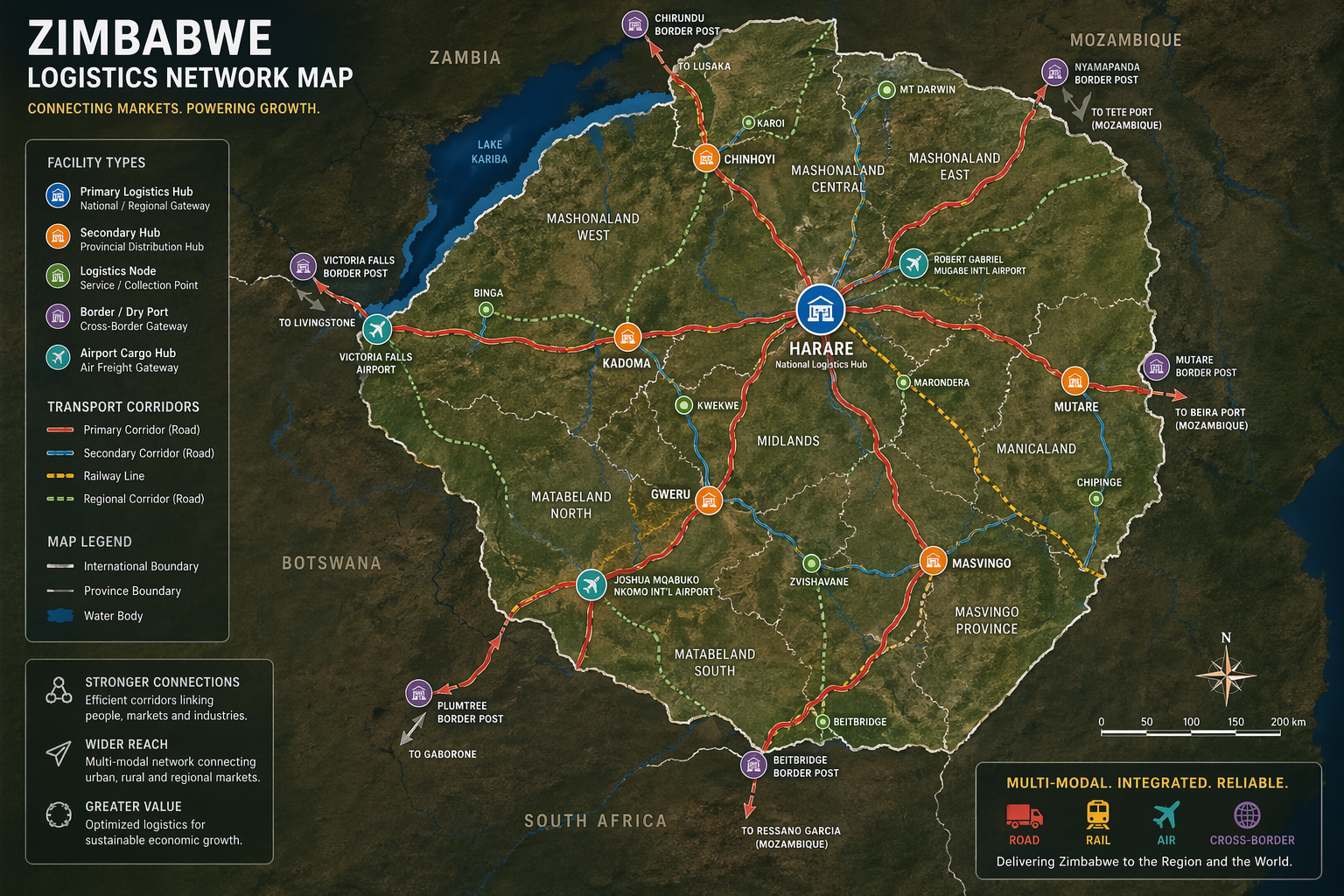
A truck reaches Victoria Falls Border Post with a commercial consignment that has already left Zambia’s customs system. The declaration data can now reach the Zimbabwean side before the driver reaches the counter. That changes the conversation from re-entering basic information to resolving a mismatch, a missing document or a risk query.
Customs data exchange has become an important part of trade compliance in Southern Africa. For importers, exporters and logistics businesses, it affects how they prepare declarations, retain evidence and manage border delays. It does not remove the need for sound customs documentation.
As of September 2026, the most visible operational example links the Zambia Revenue Authority, ZRA, and the Zimbabwe Revenue Authority, ZIMRA, at Victoria Falls. South Africa’s SARS also maintains formal information-sharing and trusted-trader arrangements with several regional counterparts. Botswana’s customs authority is the Botswana Unified Revenue Service, BURS, not the Botswana Revenue Authority.
What customs-to-customs data exchange means
Customs-to-customs data exchange occurs when revenue authorities share customs information directly across a border or under a formal cooperation arrangement. The information can include import, transit and export declarations, risk information, origin data and compliance records, depending on the arrangement.
This is different from a trader filing an electronic declaration with a customs authority. A trader still submits information to the relevant authority. The authorities then use their own systems and legal arrangements to compare, reconcile or assess that information.
The distinction matters because businesses often hear that a border is “paperless” and assume that permits, invoices, certificates of origin and inspection requirements have disappeared. They have not. Customs officers may still request supporting evidence where the declaration, goods, origin claim or risk profile requires it.
The regional foundation
SADC’s Protocol on Trade, Annex II on Customs Co-operation, calls on Member States to modernise and simplify customs procedures, share information, cooperate in investigations and suppress customs offences. This provides the policy direction for cooperation. It does not create one regional customs declaration or one regional duty rate.
For enterprise leaders, the practical point is straightforward. A number entered in one customs jurisdiction may now be compared against information available in another. A weak valuation explanation, inconsistent commodity description or unsupported origin claim can therefore create questions beyond the border where it first appeared.
The arrangements businesses should know
ZRA and ZIMRA at Victoria Falls
ZRA and ZIMRA introduced cross-border clearance data exchange at Victoria Falls Border Post with effect from 11 December 2023. The arrangement covers paperless exchange of import, transit and export declarations for commercial cargo.
The stated operational aims include pre-clearance, faster release, declaration harmonisation and reconciliation of trade-data mismatches. ZRA’s 2024 reporting confirms that it established electronic interfaces with Zimbabwe for customs-data exchange. That matters because it shows an operating interface, rather than a proposal that remained on paper.
A common mistake is to describe this initiative as a new duty, tariff or border charge. It concerns customs information and clearance administration. Businesses should still confirm the tariff treatment, taxes, permits and product-specific controls that apply to their own goods.
SARS and customs mutual administrative assistance
SARS describes Mutual Administrative Assistance agreements, known as MAAs, as arrangements that allow customs administrations to exchange information, assist each other technically, conduct joint surveillance and investigations, and improve operational efficiency.
SARS lists a customs MAA with Zimbabwe effective from 1 October 2015. It lists a customs MAA with Zambia effective from 27 December 2017, as well as a Zambia protocol effective from 27 October 2022.
An MAA has a wider purpose than expedited treatment at a border. It can support investigations and compliance work. If your business trades through South Africa, Zimbabwe or Zambia, treat customs declarations as records that may face cross-border scrutiny, particularly where the transaction involves related parties, repeated corrections or an origin preference.
AEO mutual recognition and what it does
An Authorised Economic Operator, AEO, arrangement focuses on recognised compliant traders. It is not the same as a broad mutual administrative assistance agreement.
SARS reports a SACU regional AEO mutual-recognition arrangement with BURS, Eswatini Revenue Service, Revenue Services Lesotho and Namibia Revenue Agency. It took effect on 31 May 2023 and enables reciprocal AEO treatment and exchange of AEO-related information.
SARS also records an AEO mutual-recognition arrangement with ZRA, effective 16 May 2025. It allows the two administrations to share AEO-related information and provide agreed reciprocal facilitation to recognised compliant traders.
Do not pursue AEO recognition merely because you cross a border once or twice a year. It requires sustained compliance discipline and internal controls. It makes more strategic sense for an enterprise with regular cross-border volumes, predictable supply chains and a governance team that can maintain the supporting records.
Electronic certificates of origin
In March 2025, SADC reported that Botswana and Zambia were among the countries engaged in electronic certificate-of-origin data exchange. Zimbabwe had completed development of its e-CoO module.
This development deserves attention from manufacturers, distributors and exporters who rely on preferential origin treatment. Origin is not a marketing description on an invoice. It depends on the applicable rules and evidence behind the production, processing and sourcing of the goods.
A step-by-step response for cross-border businesses
1. Map each declaration from order to border
Start with one regular shipment route, such as Lusaka to Victoria Falls to Zimbabwe, or a South African import route into the region. List the commercial invoice, packing list, transport document, tariff classification, valuation support, permits and origin evidence that feed the declaration.
Then identify who supplies each field. Sales teams often describe goods differently from procurement teams, while clearing agents receive a shortened product description. Customs data exchange exposes these differences because authorities can compare the declared information across transactions and jurisdictions.
Take an illustrative agricultural-input distributor that moves fertiliser from Zambia into Zimbabwe every month. Its sales invoice says “fertiliser blend,” while its clearing instruction uses a more specific product description and its packing list shows different quantities after a warehouse adjustment. The business may face a delay while the parties reconcile a discrepancy that began in its own records. Before the next shipment, management should assign one approved product-description master and require a documented sign-off for quantity changes.
2. Test the fields customs authorities can compare
Review the data points that commonly drive questions: exporter and importer details, commodity description, quantities, gross and net mass, declared value, country of origin, transit movement and transport references. The purpose is not to make every document identical where legitimate differences exist. The purpose is to explain differences before an officer asks.
The step many businesses skip is a pre-clearance reconciliation between the invoice, packing list and declaration instruction. A finance manager may approve the invoice while an operations manager sends the clearing instruction, with no final comparison. Build this review into your customs compliance process for every material shipment.
For higher-value cargo, ask the clearing agent to return the key declaration data for management approval before submission. That is especially useful when a shipment uses a preferential origin claim or includes goods with product permits. The cost of a short internal review is usually lower than the cost of a vehicle waiting while a mismatch is investigated.
3. Keep origin evidence separate and accessible
Electronic certificate-of-origin exchange does not mean customs will accept an unsupported claim. Keep supplier declarations, bills of materials, manufacturing records and any certificate relevant to the preference claimed. The exact evidence depends on the applicable trade arrangement and product.
An illustrative manufacturer in Gaborone exports packaged goods through South Africa and uses regional origin preferences on selected lines. The finance team retains invoices, but the production team holds supplier and processing evidence in separate folders without a shipment reference. When a query arises, the business spends several days assembling a file that it should have prepared at dispatch. It would reduce that exposure by keeping an origin dossier under the same reference as the export declaration and commercial invoice.
If you cannot explain why goods qualify as originating, do not make the preference claim until your team has checked the evidence. The immediate duty saving may not justify a later assessment, delay or compliance dispute.
4. Separate filing obligations from authority exchange
Do not assume that customs-to-customs data exchange replaces electronic filing requirements in the jurisdiction where you lodge declarations. South Africa provides a clear example.
SARS requires EDI for specified cargo reports and goods declarations. Importers, exporters and customs agents generally register as EDI users, except where they submit fewer than 10 customs clearance declarations each month and each declaration has no more than 10 lines.
The South African process uses forms DA 185, DA 185.4A6 and an EDI User Agreement under Government Notice R814 of 31 July 2009. If your South African operation clears above that limited exception, plan for EDI governance rather than treating filing as an occasional administrative task.
We recommend that executives include customs controls in digital transformation planning. Your ERP, warehouse system, finance records and clearing-agent instructions should draw from controlled master data. A customs compliance review can identify where those systems produce conflicting descriptions, values or quantities.
5. Decide who owns the response to a customs query
A clearing agent may lodge a declaration, but the importer or exporter still needs a responsible internal owner for the commercial facts behind it. Name a customs coordinator and give that person authority to obtain answers from procurement, finance, logistics and product teams.
Prepare a query pack before issues arise. It should include the declaration instruction, final invoice, packing list, transport documents, proof of payment where relevant, product specifications, permits and origin records. Keep it by shipment reference so that a cross-border question does not become a search through personal email inboxes.
What data exchange does not change
Customs data exchange does not set a regional tariff rate. It does not guarantee immediate release. It does not remove an authority’s right to inspect goods or request documentary support.
It also does not convert every trader into a recognised AEO. AEO status and mutual recognition apply to businesses that meet the relevant recognition requirements. A mutual administrative assistance agreement serves a different compliance and enforcement purpose.
For boards, this is a governance issue as much as a border issue. Revenue authorities can improve reconciliation and identify inconsistencies more quickly when they have better information. Your enterprise should therefore measure declaration amendments, post-clearance queries, border delays and origin-related exceptions as part of its trade risk reporting.
Frequently Asked Questions
Is customs data exchange a new tax on regional trade?
No. The arrangements described here support the exchange and reconciliation of customs information. Duties, taxes and applicable charges still depend on the goods, tariff treatment and jurisdiction.
Does ZRA and ZIMRA data exchange eliminate documents at Victoria Falls?
No. The ZRA-ZIMRA interface supports paperless exchange of import, transit and export declarations for commercial cargo. Customs may still request invoices, permits, origin evidence or other supporting documents.
Is BURS the Botswana Revenue Authority?
No. The correct name is Botswana Unified Revenue Service, abbreviated as BURS. Use the correct authority name in internal policies, board papers and customs correspondence.
Are MAA and AEO arrangements the same?
No. MAAs support broader customs cooperation, information exchange and investigations. AEO mutual recognition concerns recognised compliant traders and agreed reciprocal facilitation.
A strong customs process begins before company registration in a new market and continues through each shipment, declaration and audit trail. If your organisation is expanding across Southern Africa or reviewing a cross-border supply chain, Speak With Our Team about a strategic customs compliance review.