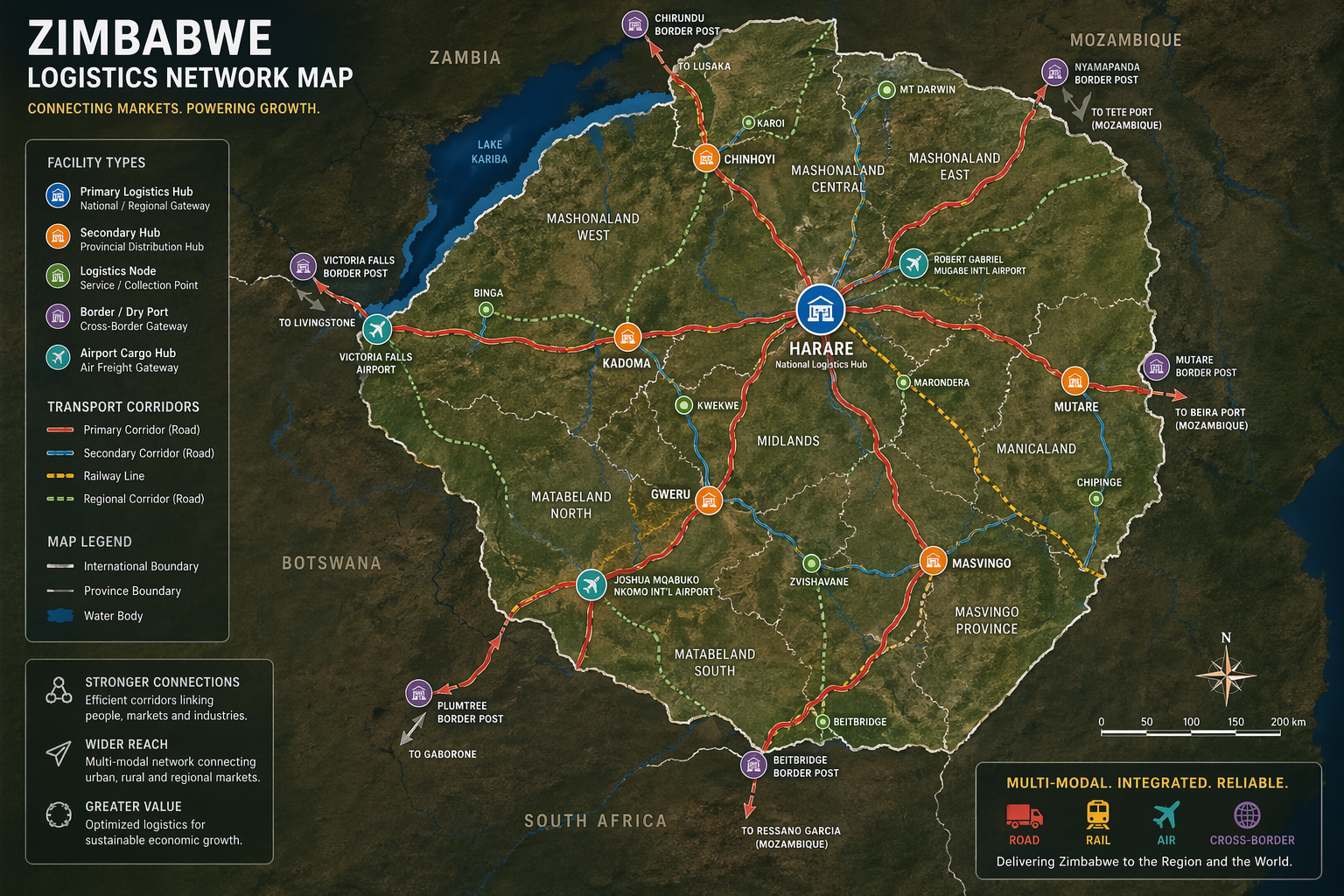
Zimbabwean businesses have faced a defining stress test between 2025 and 2026. A severe drought disrupted agricultural output and energy generation, while persistent currency volatility complicated pricing, procurement, and financial planning. For many companies, these shocks exposed deep vulnerabilities in supply chain design.
The lesson is clear. Resilience is no longer optional. It is a core strategic capability that determines whether a business can survive and compete in Zimbabwe’s evolving economic environment.
This article examines how the dual pressures of climate shocks and currency instability have reshaped supply chain thinking, and what practical steps businesses must take to build durable, adaptive systems.
Understanding the Impact of the 2025–2026 Drought
Zimbabwe’s economy remains closely tied to agriculture, both directly and indirectly. The 2025–2026 drought significantly reduced crop yields, particularly maize and other staples, triggering ripple effects across multiple industries.
Food processing companies faced raw material shortages. Retailers struggled with inconsistent supply. Manufacturing businesses reliant on agricultural inputs experienced production delays. At the same time, reduced water levels affected hydroelectric power generation, leading to increased energy disruptions.
The drought highlighted a fundamental risk in Zimbabwean supply chains. Over-reliance on predictable seasonal outputs is no longer viable in an era of climate uncertainty. Businesses must now plan for variability as a baseline condition rather than an exception.
Currency Volatility and Its Supply Chain Consequences
Alongside environmental pressures, currency instability has created a second layer of disruption. Zimbabwe’s multi-currency environment, combined with fluctuations in exchange rates, has made cost management increasingly complex.
Import-dependent businesses have been particularly affected. Sudden currency movements can significantly alter input costs, eroding margins and forcing frequent price adjustments. Suppliers may demand payment in stable currencies, while customers often transact in local currency, creating mismatches that strain cash flow.
This volatility also complicates long-term contracts. Fixed pricing agreements become risky when exchange rates shift unpredictably, leading many businesses to shorten contract cycles or include adjustment clauses.
The combined effect is a supply chain environment where both physical and financial flows are unstable.
Rethinking Supply Chain Design for Resilience
The disruptions of 2025–2026 have forced businesses to rethink traditional supply chain models. Efficiency alone is no longer sufficient. Systems must be designed to absorb shocks and adapt quickly.
Resilience begins with diversification. Companies that relied on a single supplier or geographic source were among the hardest hit during the drought. In contrast, those with multiple sourcing options were better able to maintain continuity.
Geographic diversification is particularly important. Sourcing from different regions, both within and outside Zimbabwe, reduces exposure to localized disruptions such as drought or infrastructure failures.
At the same time, businesses are re-evaluating inventory strategies. Just-in-time models, while efficient, leave little room for error in volatile environments. Many companies are now holding strategic buffer stock to mitigate supply interruptions.
Localization vs. Regionalization: Finding the Balance
One of the most important strategic questions is whether to localize supply chains or expand regionally. The drought exposed the risks of relying solely on domestic production, but regional sourcing comes with its own challenges, including logistics costs and cross-border regulations.
The most effective approach is often a hybrid model. Local sourcing can provide speed and familiarity, while regional suppliers offer diversification and risk spreading. By combining both, businesses can create more flexible supply networks.
Regional trade agreements within Southern Africa also present opportunities. Companies that actively engage with these frameworks can access broader supplier bases and reduce dependency on any single market.
Digital Transformation as a Resilience Enabler
Technology has emerged as a critical tool for managing supply chain complexity. Businesses that invested in digital systems were better equipped to respond to disruptions during the 2025–2026 period.
Real-time data visibility allows companies to track inventory, monitor supplier performance, and anticipate disruptions. Advanced analytics can identify patterns and support more informed decision-making.
Digital payment systems also play a role in managing currency risk. By enabling multi-currency transactions and faster settlements, they help businesses navigate financial volatility more effectively.
However, technology alone is not enough. It must be integrated into broader operational strategies and supported by skilled personnel.
Supplier Relationships and Collaboration
Resilient supply chains are built on strong relationships. During periods of disruption, transactional approaches often break down, while collaborative partnerships prove more sustainable.
Businesses that maintained open communication with suppliers were better able to negotiate flexible terms, secure priority access to limited resources, and coordinate responses to challenges.
Long-term partnerships also encourage mutual investment in resilience. Suppliers are more likely to prioritize clients who demonstrate commitment and reliability.
Financial Strategies for Managing Volatility
Supply chain resilience is as much a financial challenge as an operational one. Currency fluctuations require businesses to adopt more sophisticated financial strategies.
Hedging mechanisms, where available, can provide some protection against exchange rate movements. Pricing models must also be flexible, allowing for adjustments without alienating customers.
Cash flow management becomes critical in this context. Businesses need to ensure they have sufficient liquidity to absorb shocks, particularly when input costs rise, payments are delayed.
Risk Management and Scenario Planning
The events of 2025–2026 underscore the importance of structured risk management. Businesses can no longer rely on assumptions of stability.
Scenario planning is a powerful tool in this regard. By modelling different disruption scenarios, companies can identify vulnerabilities and develop contingency plans. This proactive approach enables faster and more effective responses when disruptions occur.
Risk management frameworks should cover both physical risks, such as supply disruptions, and financial risks, including currency volatility.
The Role of Policy and Infrastructure
While businesses must take responsibility for their own resilience, the broader operating environment also plays a role. Infrastructure limitations, regulatory uncertainty, and policy shifts can either support or hinder supply chain stability.
Engagement with policymakers and industry bodies is therefore important. Businesses that actively participate in dialogue can help shape more supportive environments and stay informed about upcoming changes.
Strategic Lessons for Zimbabwean Businesses
The combined impact of drought and currency shifts has provided several clear lessons. Resilience requires diversification, both in sourcing and markets. It demands investment in technology and systems that provide visibility and control. It depends on strong relationships and collaborative approaches. Most importantly, it requires a shift in mindset from efficiency to adaptability.
Companies that internalize these lessons will be better prepared for future disruptions, whether they arise from climate events, economic shifts, or global shocks.
Conclusion: Resilience as a Competitive Advantage
The challenges of 2025–2026 have redefined what it means to operate successfully in Zimbabwe. Supply chain resilience is no longer a defensive measure. It is a source of competitive advantage.
Businesses that invest in adaptable systems, diversify their networks, and strengthen their financial strategies will not only survive future shocks but emerge stronger. Those that fail to adapt risk being left behind in an increasingly unpredictable environment.
Call to Action (CTA)
If your business operates in Zimbabwe, now is the time to assess your supply chain resilience. Review your sourcing strategies, strengthen supplier relationships, and invest in systems that provide visibility and flexibility. The next disruption is not a question of if, but when.