
Introduction
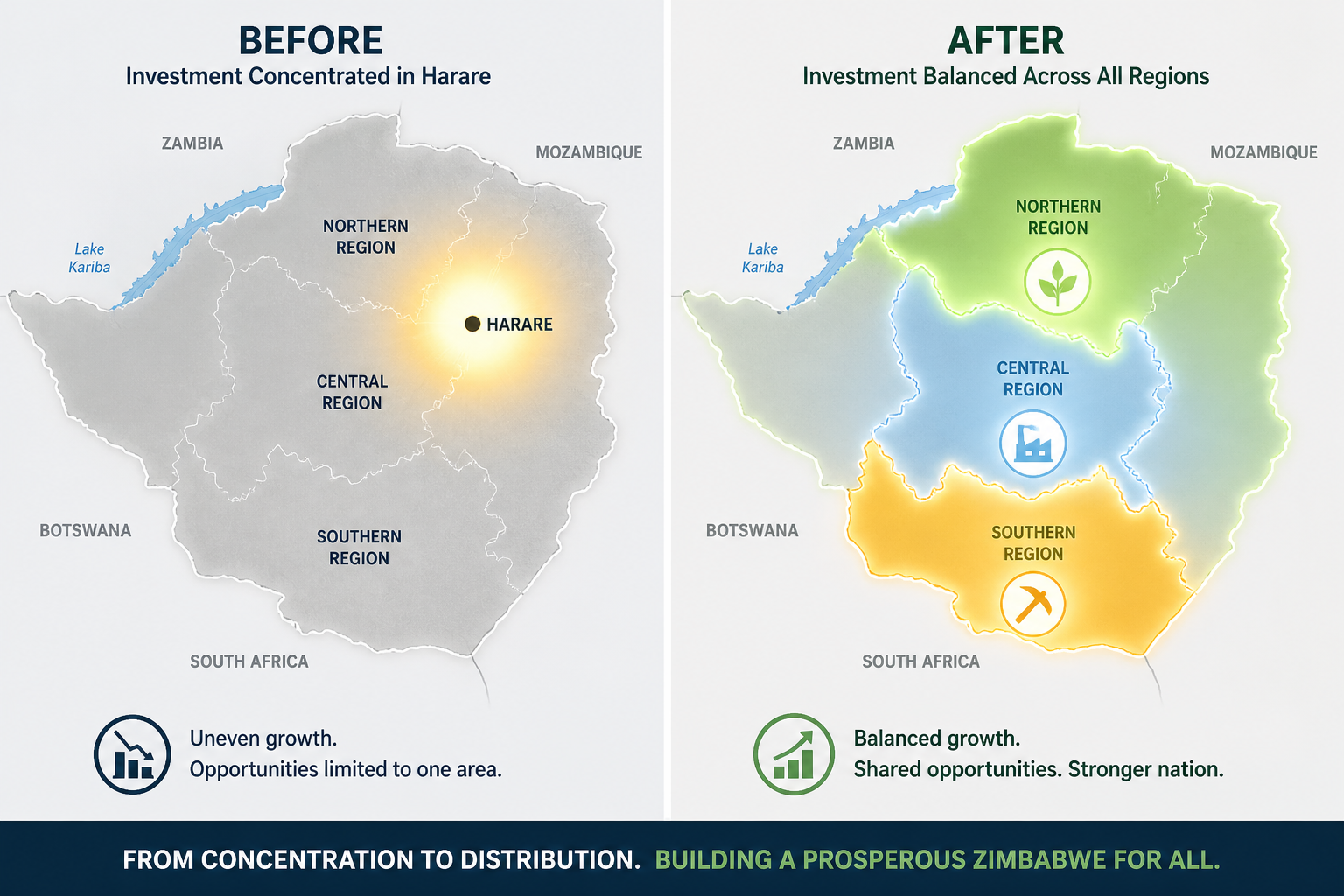
One of the most overlooked risks in Zimbabwean investment portfolios is regional concentration risk, the tendency to cluster capital in a single economic hub, most commonly Harare.
While Harare remains the commercial nerve centre of the country, overexposure to one province introduces structural vulnerabilities that can undermine long-term returns.
A well-designed Zimbabwe regional investment strategy distributes exposure across multiple provinces, particularly Midlands and Masvingo, to balance growth, resilience, and sector diversification.
This is not simply geographic diversification. It is a strategic allocation of capital across distinct economic ecosystems.
What Is Regional Concentration Risk, and Why It Matters
Regional concentration risk occurs when investments are heavily focused in one location, exposing the portfolio to localized disruptions.
In Zimbabwe, these risks can include:
- Policy enforcement variations at provincial level
- Infrastructure bottlenecks in specific regions
- Localized economic slowdowns
- Utility supply disruptions (power, water)
- Urban market saturation
For investors concentrated in Harare, these risks are amplified by:
- Increasing competition
- Rising operational costs
- Limited expansion space
Diversifying across provinces reduces these risks while unlocking new growth channels.
Why Harare Alone Is No Longer Enough
Harare offers undeniable advantages:
- Established financial ecosystem
- Access to decision-makers and regulators
- Strong consumer market
- Better infrastructure relative to other regions
However, these strengths also create constraints.
Rising Cost Structures
- Higher property and rental costs
- Increased labour competition
- Elevated operating expenses
Market Saturation
Many sectors particularly retail, services, and light manufacturing, are becoming crowded.
Overexposure Risk
Any disruption in Harare, whether economic, political, or infrastructural, can disproportionately impact a concentrated portfolio.
The Case for a Multi-Province Investment Strategy
A multi-province approach distributes capital across complementary regional strengths, rather than duplicating the same business model in different locations.
The goal is to create:
- Revenue diversification
- Supply chain resilience
- Sectoral balance
- Cost efficiency
Midlands and Masvingo are not alternatives to Harare—they are strategic extensions.
Midlands: Zimbabwe’s Industrial and Logistics Core
The Midlands province is one of the most strategically positioned regions in Zimbabwe.
Key advantages include:
Central Geographic Location
Midlands sits at the crossroads of major transport routes, making it ideal for:
- Distribution hubs
- Logistics operations
- Regional supply chain management
Strong Industrial Base
Cities like Gweru and Kwekwe support:
- Manufacturing
- Metal processing
- Mining-related industries
This makes Midlands ideal for production-focused investments.
Lower Operating Costs
Compared to Harare:
- Land is more affordable
- Labour costs are lower
- Expansion opportunities are greater
Investment Strategy in Midlands
Best-fit sectors include:
- Manufacturing and assembly plants
- Warehousing and logistics
- Agro-processing facilities
Midlands works best as the operational backbone of a diversified portfolio.
Masvingo: Agriculture, Tourism, and Emerging Value Chains
Masvingo offers a different, but equally valuable, investment profile.
Agricultural Strength
The province is known for:
- Livestock production
- Sugarcane and crop farming
- Agro-processing potential
This creates opportunities in:
- Food production
- Processing and packaging
- Export-oriented agriculture
Tourism Potential
Home to major attractions like:
- Great Zimbabwe (heritage site)
- Wildlife and eco-tourism zones
This supports investments in:
- Hospitality
- Travel services
- Tourism infrastructure
Untapped Market Opportunities
Masvingo remains underdeveloped relative to Harare, which means:
- Less competition
- First-mover advantage
- Lower entry costs
Investment Strategy in Masvingo
Best-fit sectors include:
- Agro-processing and agribusiness
- Tourism and hospitality
- Renewable energy (supporting rural operations)
Masvingo adds long-term growth and diversification to the portfolio.
Designing the Multi-Province Portfolio
A strong Zimbabwe regional investment strategy does not spread capital randomly—it allocates it intentionally.
Step 1: Define Functional Roles for Each Province
- Harare: Commercial, financial, and administrative hub
- Midlands: Production, logistics, and industrial base
- Masvingo: Agriculture, tourism, and resource-linked growth
Step 2: Build Inter-Provincial Linkages
The real strength comes from integration.
Example:
- Manufacturing plant in Midlands
- Distribution and sales office in Harare
- Raw material sourcing or agro-processing in Masvingo
This creates a connected value chain, not isolated investments.
Step 3: Diversify Revenue Streams
Ensure that income is generated from:
- Urban consumer markets (Harare)
- Industrial output (Midlands)
- Agricultural or tourism sectors (Masvingo)
Step 4: Structure for Risk Mitigation
Use:
- Separate legal entities per province
- Holding company structures
- Risk ring-fencing mechanisms
This protects the overall portfolio from localized shocks.
Infrastructure and Logistics Considerations
A multi-province strategy requires careful planning around:
- Transport networks (road and rail connectivity)
- Power supply consistency
- Storage and warehousing
- Digital connectivity
Midlands’ central location often serves as the logistical anchor, reducing transport inefficiencies.
Financial Structuring and Capital Allocation
Investors should avoid equal capital distribution.
Instead, allocate based on:
- Risk profile
- Return potential
- Capital intensity
Example approach:
- Higher capital allocation to Midlands (industrial assets)
- Moderate allocation to Harare (commercial operations)
- Strategic, growth-focused allocation to Masvingo
Common Mistakes to Avoid
Even experienced investors make critical errors when attempting regional diversification.
Replicating the Same Business Model Everywhere
Each province has unique dynamics. Copy-pasting a Harare model into Masvingo often fails.
Ignoring Local Market Conditions
Provincial differences in:
- Consumer behaviour
- Infrastructure
- Regulatory enforcement
must be factored in.
Underestimating Logistics Complexity
Poor coordination between provinces can erode margins.
Over-Diversification
Spreading too thin across too many regions reduces operational efficiency.
Focus on strategic concentration with diversification.
The Strategic Advantage: Resilience + Growth
A well-structured regional portfolio offers:
- Protection against localized disruptions
- Access to multiple economic drivers
- Improved cost efficiency
- Stronger long-term scalability
In a market like Zimbabwe, resilience is just as important as growth.
The Bigger Picture: Aligning with National Development Trends
Zimbabwe’s economic direction increasingly supports:
- Decentralized industrial growth
- Regional value chain development
- Infrastructure expansion beyond Harare
Investors who align with this trend will benefit from:
- Policy support
- Incentives
- Emerging regional opportunities
Conclusion
Regional concentration risk is one of the most underestimated threats to investment performance in Zimbabwe.
A deliberate, well-structured multi-province investment strategy across Midlands, Harare, and Masvingo transforms that risk into opportunity.
By aligning each province with a specific role, commercial, industrial, and agricultural, investors can build portfolios that are not only profitable, but resilient and scalable.
Call to Action
If you are building or expanding an investment portfolio in Zimbabwe, now is the time to rethink geographic concentration.
Focus on:
- Structuring across multiple provinces
- Building integrated value chains
- Aligning investments with regional strengths
The investors who win in Zimbabwe will not be those who concentrate, but those who structure intelligently across regions.

![The Guide To Investing In Zimbabwe [FREE PDF]](/images/blog/the-guide-to-investing-in-zimbabwe-free-pdf.png)