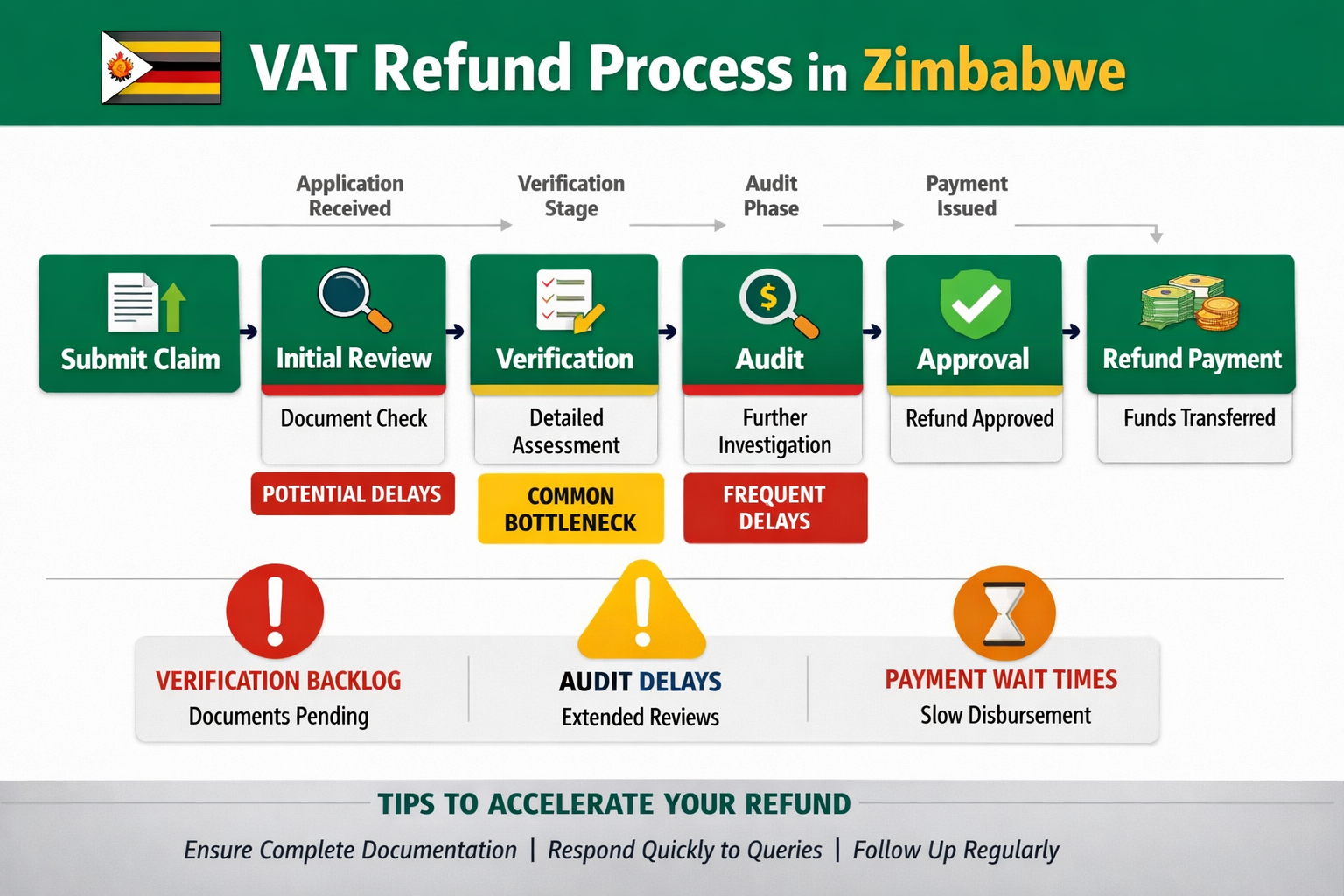
Introduction
VAT refunds are one of the most frustrating areas of tax administration for many Zimbabwean businesses.
Across sectors such as:
- manufacturing,
- mining,
- agriculture,
- logistics,
- retail,
- and export trading,
companies frequently experience delays in recovering VAT credits from the Zimbabwe Revenue Authority.
For some businesses, delayed VAT refunds create serious cash flow pressure.
This is especially true for:
- exporters,
- zero-rated suppliers,
- capital-intensive industries,
- and businesses making significant input purchases.
In difficult economic environments, delayed VAT recovery can:
- weaken working capital,
- slow operations,
- delay expansion,
- and increase financing costs.
Understanding why VAT refunds become delayed is therefore critically important for Zimbabwean businesses.
While refund delays are sometimes caused by broader administrative processes, many claims are slowed by:
- incomplete documentation,
- compliance inconsistencies,
- reconciliation problems,
- or audit triggers.
Businesses that understand the refund process and prepare strategically can often improve processing outcomes significantly.
Why VAT Refunds Matter
VAT systems are designed to avoid double taxation.
Businesses charge VAT on sales while recovering VAT paid on eligible business inputs.
When input VAT exceeds output VAT, businesses may become entitled to refunds or credits.
This is particularly common for:
- exporters,
- manufacturers,
- construction companies,
- mining operations,
- and businesses investing heavily in capital equipment.
Timely VAT recovery is therefore essential for healthy business cash flow.
Why VAT Refunds Get Delayed
Several factors commonly contribute to refund delays in Zimbabwe.
Incomplete Supporting Documentation
One of the biggest causes of delayed claims is incomplete or inconsistent documentation.
Businesses may fail to provide:
- valid tax invoices,
- proof of payment,
- customs documentation,
- export records,
- or supplier verification details.
Missing documentation creates audit risk and often slows processing significantly.
Reconciliation Problems
ZIMRA frequently reviews:
- VAT returns,
- supplier declarations,
- customs records,
- and financial statements
during refund verification processes.
If inconsistencies appear between submitted records, refund processing may be delayed pending clarification.
Common reconciliation issues include:
- invoice mismatches,
- incorrect VAT calculations,
- duplicate claims,
- and unsupported input credits.
High-Risk Industry Reviews
Some industries face increased scrutiny because of historical fraud risks or refund complexity.
This may include:
- fuel trading,
- mining,
- export businesses,
- and high-volume trading operations.
Larger refund claims often trigger additional review procedures.
Weak Internal Controls
Businesses operating with fragmented accounting systems and poor record management frequently experience refund delays.
Manual systems increase the likelihood of:
- missing invoices,
- inconsistent records,
- and inaccurate reporting.
Strong internal controls improve refund readiness significantly.
How Businesses Can Accelerate VAT Refund Processing
Although businesses cannot control every aspect of the tax administration process, several strategies can improve refund outcomes.
Maintain Accurate Digital Records
Digital accounting and ERP systems improve:
- invoice tracking,
- transaction reconciliation,
- document retrieval,
- and audit readiness.
Businesses with organized digital records generally respond to verification requests faster and more accurately.
Strengthen VAT Reconciliations
Businesses should perform regular reconciliations between:
- VAT returns,
- accounting systems,
- supplier invoices,
- and customs documentation.
This helps identify discrepancies before submission.
Proactive reconciliation reduces the risk of refund disputes and audit delays.
Ensure Supplier Compliance
Businesses should verify that suppliers:
- issue valid tax invoices,
- maintain active tax registration,
- and comply with VAT requirements.
Supplier non-compliance can sometimes affect refund verification processes.
Prepare for Audits Early
Refund claims — especially large claims — may trigger reviews or audits.
Businesses should therefore maintain:
- organized supporting documentation,
- export evidence,
- payment confirmations,
- and transaction records.
Audit readiness significantly improves response efficiency.
Why ERP Systems Improve VAT Management
Integrated ERP systems provide major advantages for VAT management.
ERP platforms help businesses:
- automate reconciliations,
- centralize documentation,
- improve reporting accuracy,
- and strengthen compliance visibility.
This reduces:
- manual errors,
- missing records,
- and delayed reporting.
Businesses with stronger operational systems are often better positioned during refund verification processes.
VAT Refund Delays and Cash Flow Pressure
Delayed VAT refunds can severely affect working capital.
Businesses may experience:
- supplier payment pressure,
- operational delays,
- financing strain,
- and reduced expansion capacity.
Some businesses compensate by increasing borrowing, which raises financing costs further.
Efficient VAT management is therefore not simply a tax issue.
It is a strategic financial management issue.
The Future of VAT Administration in Zimbabwe
Tax systems globally are becoming increasingly digital and data-driven.
Zimbabwe is likely to continue expanding:
- electronic tax systems,
- digital compliance monitoring,
- e-invoicing,
- and automated verification processes.
Businesses relying on manual systems may face increasing compliance challenges over time.
Digital operational systems will become increasingly important for:
- audit readiness,
- reporting accuracy,
- and tax efficiency.
Conclusion
VAT refund delays remain a major challenge for many Zimbabwean businesses.
However, many delays are linked to:
- weak documentation,
- reconciliation problems,
- poor internal controls,
- and fragmented reporting systems.
Businesses that improve:
- digital record management,
- compliance preparation,
- and operational visibility
can often strengthen refund processing outcomes significantly.
As Zimbabwe’s tax environment becomes increasingly digital, businesses with stronger systems and better compliance discipline will be better positioned to manage VAT recovery efficiently.
Call to Action
Businesses experiencing VAT refund delays should assess whether their current systems support:
- accurate reconciliations,
- digital document management,
- audit readiness,
- and real-time compliance visibility.
Improving internal controls and financial reporting processes can help reduce refund friction and strengthen long-term operational resilience.