Introduction
For years, African companies have chased valuation milestones, $100 million, $500 million, and ultimately the symbolic $1 billion mark. But in Zimbabwe, the path to that valuation is no longer just about growth metrics, profitability, or market share.
It is about where you list.
The emergence of the Victoria Falls Stock Exchange (VFEX) has introduced a structural shift in how serious businesses should think about valuation, capital raising, and investor positioning. This is not simply another exchange, it is a currency strategy, a risk management tool, and a valuation amplifier.
For companies approaching scale, the question is becoming unavoidable:
Is your business being undervalued because it is priced in the wrong market?
Understanding the Structural Problem: Valuation in the Wrong Currency
One of the biggest constraints facing companies listed on the Zimbabwe Stock Exchange (ZSE) is currency distortion.
When valuations are expressed in local currency:
- Earnings multiples become unstable
- Investor confidence is reduced
- Foreign participation is limited
- Capital raising becomes inefficient
Even fundamentally strong companies struggle to maintain consistent valuation narratives because currency volatility distorts financial signals.
This is not a performance problem, it is a market structure problem.
Enter VFEX: A Dollar-Denominated Alternative
The Victoria Falls Stock Exchange was designed to solve exactly this issue.
Operating as a US dollar-denominated exchange, VFEX allows companies to:
- Trade in a stable global currency
- Attract international investors
- Price assets more transparently
- Hedge against local currency risk
But the real story is not just stability, it is valuation expansion.
Why Dollar-Based Markets Command Higher Valuations
Globally, companies listed on hard-currency exchanges tend to enjoy:
- Higher earnings multiples
- Deeper liquidity pools
- Broader institutional participation
- Lower perceived risk premiums
This is because valuation is not purely mathematical, it is psychological and structural.
Investors price risk. And currency instability is one of the biggest risks they discount.
By listing on a dollar-based exchange like VFEX, companies effectively remove one of the largest valuation discounts applied to African businesses.
The VFEX Advantage: More Than Just Currency
1. Tax Incentives That Improve Net Returns
VFEX-listed companies benefit from a significantly more favourable tax regime compared to traditional listings.
These include:
- Reduced corporate tax rates
- Lower withholding taxes on dividends
- Exemptions on capital gains tax for foreign investors
For investors, this directly increases after-tax returns, making VFEX-listed entities more attractive.
For companies, it strengthens valuation multiples.
2. Easier Access to Offshore Capital
Capital is global, but it is selective.
International investors are often restricted from:
- Participating in local currency markets
- Repatriating funds easily
- Managing currency exposure
VFEX removes these barriers.
By aligning with global capital standards, companies can:
- Attract diaspora investment
- Engage institutional funds
- Structure cross-border capital raises
This is critical for businesses targeting $1bn+ valuations, where local capital alone is insufficient.
3. Repatriation Certainty
One of the biggest concerns for foreign investors in emerging markets is exit risk.
VFEX addresses this directly by allowing:
- Dividend payments in USD
- Capital repatriation in USD
- Transparent settlement systems
This reduces friction and builds trust, two key drivers of valuation.
4. Enhanced Corporate Visibility
Listing on VFEX positions a company differently:
- It signals international readiness
- It aligns with global reporting expectations
- It increases visibility beyond domestic markets
This is not just branding, it is strategic positioning.
The $1bn Valuation Question: Where Multiples Are Made or Lost
A $1bn valuation is rarely achieved through revenue growth alone.
It is driven by:
- Market perception
- Investor confidence
- Liquidity access
- Risk pricing
Two identical companies, same revenue, same margins, can trade at vastly different valuations depending on:
- The exchange they are listed on
- The currency they are priced in
- The investors they attract
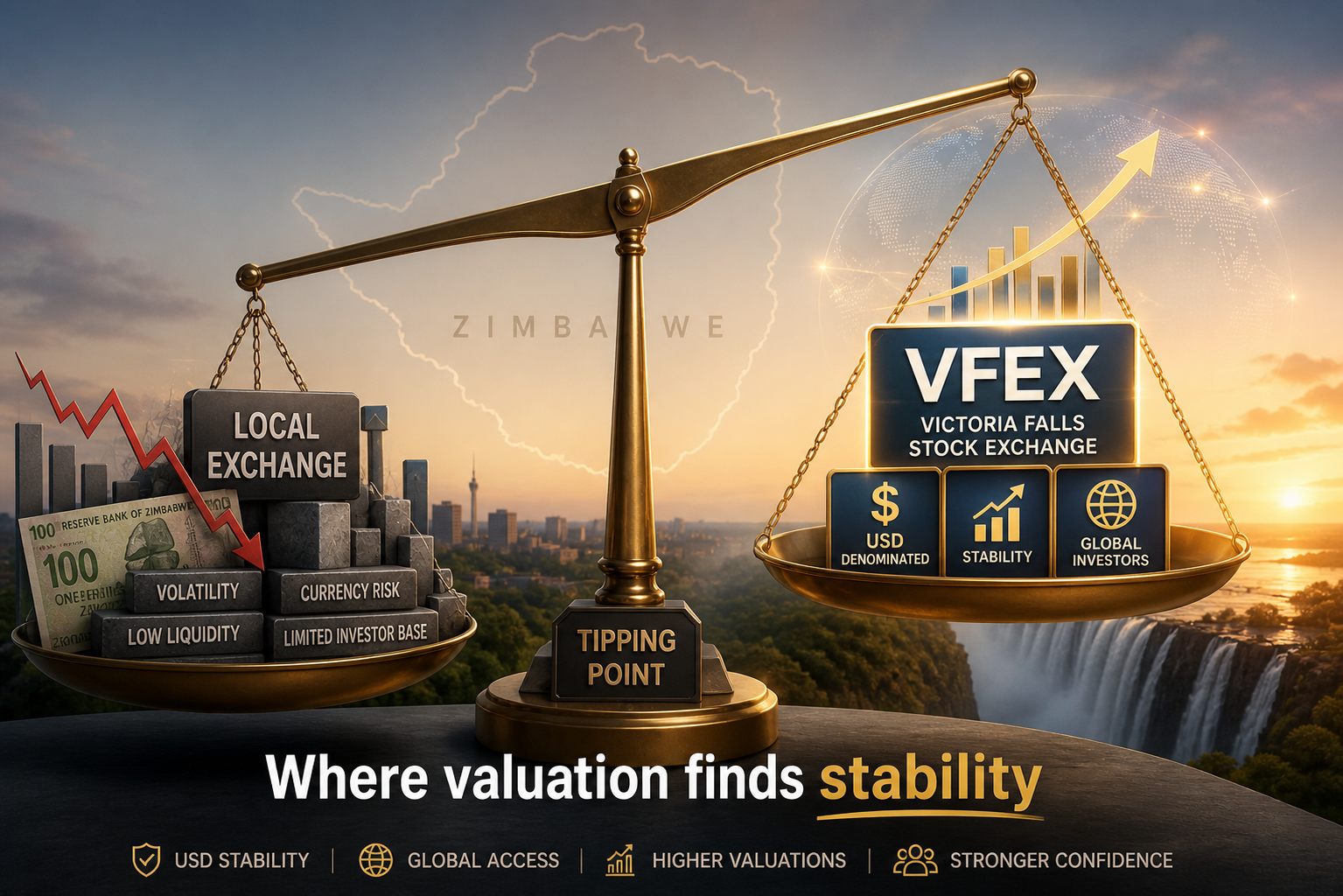
This is where VFEX becomes a tipping point.
A company stuck in a constrained, local-currency market may plateau at $300M–$500M.
The same company, repositioned on a dollar-denominated exchange, can unlock:
- Higher multiples
- Broader demand
- Stronger valuation narratives
Who Should Be Considering a VFEX Listing?
Not every business is ready, but many are closer than they think.
VFEX is particularly suited for:
Growth-Stage Companies Approaching Scale
Businesses with strong revenues, expanding operations, and clear profitability pathways.
Export-Oriented Firms
Companies earning foreign currency naturally benefit from USD alignment.
Mining and Resource Companies
Given Zimbabwe’s mineral wealth, these businesses are prime candidates for international capital.
Infrastructure and Energy Projects
Large-scale projects require long-term, stable funding, VFEX provides the platform.
Diaspora-Backed Enterprises
Businesses with international shareholder bases gain structural advantages.
When VFEX May Not Be the Right Fit
A dollar bourse is powerful, but not universal.
Companies may struggle on VFEX if they:
- Lack foreign currency revenue streams
- Have weak corporate governance structures
- Are not prepared for higher reporting standards
- Operate purely in local, informal markets
In these cases, premature listing can damage credibility rather than enhance it.
Migration Strategy: Moving from ZSE to VFEX
For companies already listed on the Zimbabwe Stock Exchange, migration is not uncommon.
A structured transition typically involves:
- Corporate restructuring
- Regulatory approvals
- Shareholder alignment
- Financial reporting adjustments
- Investor communication strategy
Done correctly, migration can act as a valuation reset.
The Bigger Picture: Zimbabwe’s Capital Market Evolution
The rise of the Victoria Falls Stock Exchange reflects a broader shift:
Zimbabwe is building parallel financial systems to compete globally.
Instead of forcing international capital into local constraints, VFEX aligns Zimbabwe with:
- Global currency standards
- Investor expectations
- Cross-border capital flows
This is not just a local development, it is part of a wider African trend toward financial market modernization.
Conclusion: The Market You Choose Determines the Value You Unlock
Reaching a $1bn valuation is not just about building a great company, it is about placing that company in the right market environment.
The reality is clear: markets reward clarity, stability, and accessibility.
The Victoria Falls Stock Exchange offers all three.
It removes currency distortion. It opens the door to global capital. It aligns your business with international valuation frameworks.
And most importantly, it allows investors to see your company without the noise of macroeconomic risk clouding the picture.
For ambitious companies, the implication is straightforward:
You can continue operating within a constrained valuation environment, or you can reposition onto a platform designed for scale.
Because at the $1bn level, valuation is no longer just about performance.
It is about structure, access, and perception.
Call to Action
If your business is scaling and capital needs are increasing, now is the time to evaluate your listing strategy.
Explore whether a VFEX listing, or migration, can unlock the valuation upside your business is already generating.
In capital markets, timing matters,
But positioning matters even more.