Introduction
Zimbabwe is actively courting foreign investment with a clarity of purpose that has not always characterized its past approach. Through the Zimbabwe Investment and Development Agency, the government has identified priority sectors, published investment-ready project prospectuses, and introduced targeted incentives designed to attract capital into agriculture, renewable energy, manufacturing, and infrastructure. For foreign investors, the message is clear: Zimbabwe is open for business, and the incentives are structured to reward those who align with the country’s development priorities.
The Institutional Framework: ZIDA and the 2026 Projects Prospectus
The Zimbabwe Investment and Development Agency has launched its 2026 Projects Prospectus, showcasing a range of investment-ready initiatives across manufacturing, agriculture, mining, energy, tourism, and infrastructure. The prospectus represents a deliberate effort to move beyond abstract investment promotion toward presenting commercially viable, feasibility-backed ventures capable of attracting institutional investors, financiers, and strategic partners.
ZIDA has also published its 2026 Investment Regulatory Bulletin, consolidating recent regulatory changes across multiple sectors to provide investors with a single, authoritative source of policy guidance. This transparency initiative reduces the information asymmetry that has historically deterred foreign capital.
Key regulatory reforms highlighted in the bulletin include:
- Relaxation of financing restrictions for cotton and tobacco, allowing enterprises to use domestic and foreign financing, self-owned funds, or local borrowing to support procurement.
- Reclassification of tobacco buyers as “exporters,” with foreign exchange settlement requirements applied only to net foreign exchange earnings, improving profitability.
- Significant reductions in Special Economic Zone fees, including halving of licensing and operating fees, and reduction of investor licence fees from US10,000toUS10,000_toUS_4,000, lowering market entry costs.
Priority Sector 1: Agriculture and Agro-Processing
Agriculture remains Zimbabwe’s most enduring economic asset. The government has designated agriculture and agro-processing as a central pillar of its investment strategy, with a particular focus on value addition rather than raw commodity exports.
- Vice President Constantino Chiwenga has urged industries to move away from exporting raw materials toward beneficiation and agro-processing, noting that sectors such as agriculture hold significant potential to drive sustainable growth when supported by modern processing technologies.
- The government, through the Department of Irrigation, is constructing smallholder irrigation schemes across multiple districts, creating opportunities for investors in irrigation technology, water management, and related services.
- In the horticulture sector, Manicaland Province plans to increase coffee production by 1,000 hectares annually, while a new sugar processing plant has been earmarked for Chipinge.
- The combination of Zimbabwe’s fertile land, favourable climate, and government incentives creates a compelling proposition for investors in commercial agriculture, agro-processing, and agricultural technology.
Priority Sector 2: Renewable Energy
Energy is both a critical constraint and a significant investment opportunity in Zimbabwe. The country’s ambition to generate 2,100 megawatts of power by 2030 has created a framework in which solar energy, in particular, is expected to play a leading role through public-private partnerships and increased private sector participation.
- Manicaland Province has attracted a landmark US$600 million investment pledge from South African-based Ilinge Energy Automation to establish a 400-megawatt power plant in Chimanimani.
- VS Hydro has proposed establishing mini-hydro power stations totalling 37 megawatts along multiple rivers, with feasibility studies already completed.
- The province currently produces approximately 46 megawatts from independent power producers against daily demand of 120 megawatts, with projected demand rising to 200 megawatts within three years, underscoring the urgent need for additional generation capacity.
- The government has established a Solar Technology Application Resource Centre at Chinhoyi University of Technology, in partnership with the International Solar Alliance, to build technical capacity in renewable energy technologies.
- For investors, the opportunity spans solar generation, hydroelectric projects, energy storage, and the manufacturing of renewable energy components, including the Orangerose Solar Roof Tile Manufacturing Project which aims to produce 600 solar tiles per day.
Priority Sector 3: Manufacturing and Industrial Development
Manufacturing is at the heart of Zimbabwe’s industrialization agenda. The ZIDA 2026 Projects Prospectus identifies a range of investment-ready manufacturing projects designed to reduce import dependence, boost exports, create jobs, and strengthen Zimbabwe’s integration into regional markets.
Key projects highlighted in the prospectus include:
- A US$2.4 billion concrete sleeper manufacturing plant by the National Railways of Zimbabwe in Bulawayo, expected to produce 60,000 sleepers annually and strengthen railway infrastructure.
- The Verify Coal-to-Fertiliser Plant in Mkwasine, Masvingo, which will produce 520,000 tonnes of nitrogenous fertilisers annually alongside by-products such as ammonia, oxygen, and explosives. The project incorporates carbon capture, solar energy, and CO₂ storage to minimise emissions.
- A SIRDC Integrated Foundry at Manhize Industrial Park, set to produce high-quality cast and forged products for mining, agriculture, transport, and construction.
- The Linkdef Soap Manufacturing Facility, producing 64 tonnes of bath and bar soap annually.
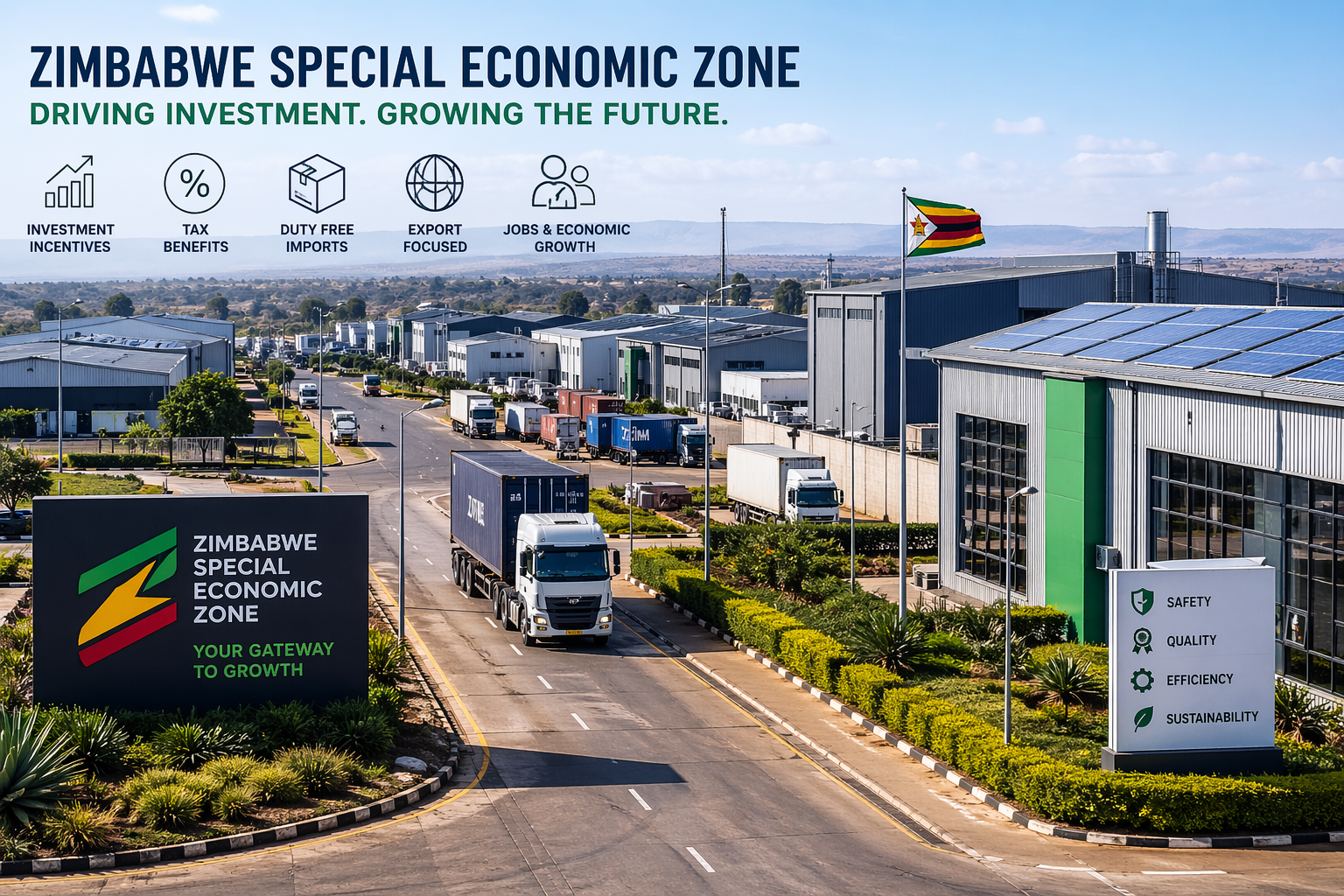
These projects demonstrate that industrial growth and environmental sustainability can progress together, with ZIDA explicitly stating that investors in these ventures can take advantage of opportunities within Special Economic Zones, including tax incentives, duty-free equipment imports, and streamlined regulatory processes.
Special Economic Zones and Tax Incentives
Zimbabwe’s Special Economic Zones offer a package of incentives designed to attract foreign investors across priority sectors.
- Licensed investors in designated SEZs benefit from reduced corporate tax rates and customs duty exemptions on approved capital equipment.
- The recent reduction in SEZ licensing fees from US10,000toUS10,000_toUS_4,000 has significantly lowered the cost of market entry for new investors.
- The Business Process Outsourcing framework provides additional targeted incentives, including a 15 percent corporate tax rate, customs duty suspensions for approved ICT infrastructure, and first-year capital expense deductions.
- The government also offers a US$1,500 Youth Employment Tax Credit for each youth worker employed annually, demonstrating commitment to job creation.
Infrastructure and Logistics Development
Investment in manufacturing and agriculture requires parallel investment in logistics and infrastructure. The government has committed to rehabilitating rail and road networks to improve logistics efficiency and reduce the cost of doing business.
- Ongoing investments in water security through the construction of mega dams and expansion of renewable energy projects aim to ensure reliable power supply for industry.
- The transformation of Mutare into a modern logistics hub along the Beira Corridor, including a new dry port providing customs clearance, warehousing, and intermodal connectivity, represents a strategic opportunity for logistics investors.
Conclusion
Zimbabwe’s priority investment sectors present a coherent and increasingly well-documented opportunity for foreign investors. The ZIDA 2026 Projects Prospectus provides feasibility-backed, investment-ready ventures across agriculture, renewable energy, manufacturing, and logistics. The regulatory reforms consolidated in the 2026 Investment Bulletin demonstrate a government actively working to reduce barriers to entry and improve the ease of doing business.
For investors, the alignment of government incentives with genuine development needs creates a proposition where commercial returns and positive local impact are mutually reinforcing. The reduction in SEZ fees, the introduction of BPO tax incentives, and the relaxation of sector-specific financing restrictions all signal a country that is serious about attracting and retaining foreign capital.
Call to Action
Explore Zimbabwe’s priority investment sectors with the following steps.
- Download the ZIDA 2026 Projects Prospectus from the agency’s website and review the detailed project profiles in your sector of interest.
- Contact ZIDA directly to understand the specific incentives available for your proposed investment, including SEZ benefits and any newly introduced fee reductions.
- Engage local professional advisers, legal, tax, and investment consultants with Zimbabwe-specific expertise, to conduct due diligence on regulatory requirements and to structure your investment for maximum benefit.
- Consider attending the Zimbabwe International Trade Fair or the Intra-African Trade Fair, which Zimbabwe hosted, to meet potential partners and government officials face-to-face.
- Align your investment with Zimbabwe’s National Development Strategy 2 priorities, as projects that demonstrate contribution to national development goals are more likely to receive streamlined regulatory approval.
Zimbabwe’s investment landscape is evolving. The incentives are available. The projects are packaged. The question is whether investors will seize the opportunity before the current window of reform yields its most attractive returns.