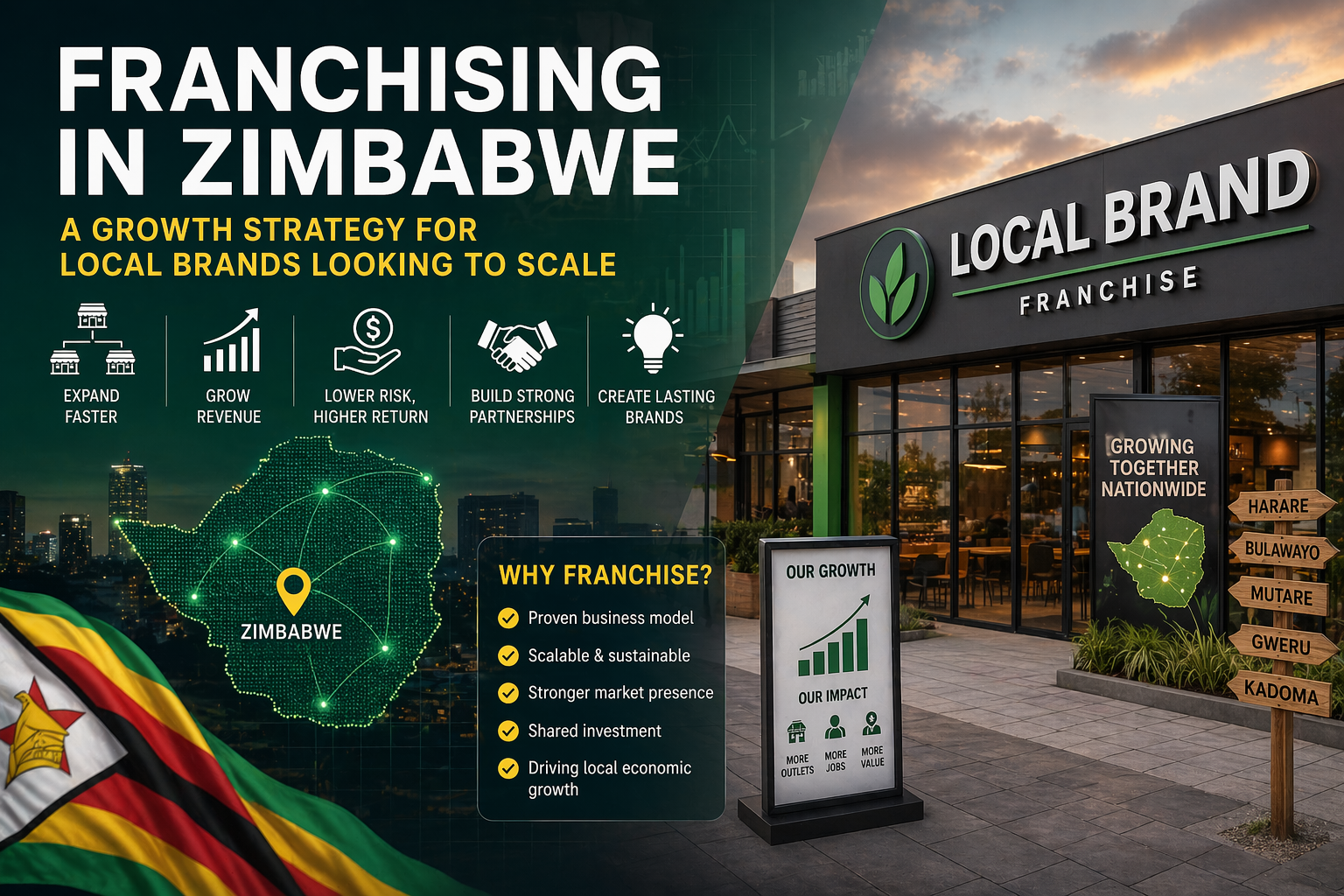
Introduction: Scaling Without Owning Everything
For many Zimbabwean businesses, growth traditionally means one thing: open more branches, hire more staff, and invest more capital.
But that model has limits.
Franchising offers a different path—one where businesses expand without carrying the full operational and financial burden of each new location. Globally proven and increasingly relevant locally, franchising is gaining traction as a viable strategy for brands looking to scale sustainably.
The question is no longer whether franchising works— it’s whether Zimbabwean brands are ready to use it effectively.
What Is Franchising, and Why It Matters
Franchising is a business model where:
- A franchisor licenses its brand, systems, and processes
- A franchisee operates a business using that model, typically in exchange for fees and ongoing royalties
Instead of expanding through wholly owned outlets, the brand grows through partners who invest their own capital.
For local businesses, this can unlock scale that would otherwise be impossible.
Why Franchising Is Gaining Ground in Zimbabwe
1. Capital Constraints Are Real
Access to financing remains a major barrier for expansion. Franchising allows businesses to:
- Grow without heavy borrowing
- Shift capital expenditure to franchisees
- Expand faster with lower financial risk
2. Strong Informal Brands Are Emerging
Zimbabwe has no shortage of:
- Popular food outlets
- Retail concepts
- Service-based businesses
Many already operate like informal franchises—consistent branding, repeatable processes, and loyal customer bases. Formalizing this into a franchise model is the logical next step.
3. Entrepreneurial Demand Is High
There is a growing class of entrepreneurs looking for:
- Proven business models
- Lower-risk entry points
- Recognizable brands
Franchising meets this demand directly.
The Strategic Benefits for Local Brands
1. Faster Market Expansion
Franchising enables:
- Rapid geographic growth
- Entry into new cities or regions
- Market penetration without central operational strain
2. Reduced Operational Burden
Instead of managing every outlet:
- Franchisees handle day-to-day operations
- The franchisor focuses on brand, systems, and support
This shifts the business from operator to system manager.
3. Recurring Revenue Streams
Franchisors typically earn:
- Initial franchise fees
- Ongoing royalties
- Supply chain margins (in some models)
This creates predictable, scalable income.
4. Brand Strengthening
A well-executed franchise network:
- Increases brand visibility
- Builds market dominance
- Creates customer familiarity and trust
The Reality Check: Where Franchising Goes Wrong
Franchising is powerful, but only when done properly.
1. Weak Systems = Failed Franchises
If your business depends on:
- Founder involvement
- Informal processes
- Inconsistent quality
…it is not ready to franchise.
Franchising requires:
- Documented systems
- Standard operating procedures (SOPs)
- Replicable processes
2. Brand Control Risks
Poorly managed franchisees can:
- Damage your brand reputation
- Deliver inconsistent customer experiences
- Create legal and operational disputes
Control mechanisms must be built into the model.
3. Legal and Contractual Complexity
Zimbabwe does not yet have a standalone franchising law. Instead, franchising operates within:
- Contract law principles
- Intellectual property protections
- Company and commercial regulations
This makes well-drafted franchise agreements essential.
4. Unrealistic Expectations
Some businesses view franchising as a quick growth hack.
It isn’t.
Building a franchise system requires:
- Time
- Investment in systems and training
- Ongoing support infrastructure
Legal and Structural Considerations
Before franchising, businesses must address:
- Trademark protection (your brand must be legally protected)
- Franchise agreements (clear rights, obligations, and termination clauses)
- Operational manuals (how the business runs day-to-day)
- Training systems (to ensure consistency)
Alignment with frameworks like the Companies and Other Business Entities Act (Chapter 24:31) is also critical, particularly where franchise entities are separately registered companies.
Is Your Business Ready to Franchise?
A simple test:
You may be ready if:
- Your business model is proven and profitable
- Processes are standardized and repeatable
- Your brand has market recognition
- You can train others to run the business successfully
You are not ready if:
- The business relies heavily on you personally
- Quality varies significantly between locations
- Systems exist “in your head” rather than on paper
A Practical Roadmap to Franchising
Step 1: Systemize the Business
Document every process, from operations to customer service.
Step 2: Protect the Brand
Register trademarks and secure intellectual property rights.
Step 3: Develop the Franchise Model
Define:
- Fees and royalties
- Support structures
- Territory rights
Step 4: Draft Legal Agreements
Engage professionals to create robust franchise contracts.
Step 5: Pilot the Model
Test with one or two franchisees before scaling aggressively.
Call to Action: From Business Owner to Brand Builder
If you are running a successful business in Zimbabwe, the question is not just how to grow, it’s how to grow without breaking your model.
Franchising offers a pathway, but only if approached strategically.
Start here:
- Evaluate whether your business is truly franchise-ready
- Document your systems and processes
- Seek legal and advisory support before launching
The brands that will dominate the next decade are not just well-run, they are well-structured.
Conclusion: Franchising Is a Discipline, Not a Shortcut
Franchising has the potential to transform local Zimbabwean businesses into regional or even continental brands.
But success depends on one key shift:
From running a business → to building a system other can run
Those who make that transition successfully will not just scale, they will multiply.